Virgin and Child in an Apse
The Virgin and Child appear in a chapel, flanked by music-making angels. Based on a lost original by Campin of about 1420, this painting is among the earliest and finest of over sixty variants. Campin’s enormously popular devotional prototype derives from thirteenth-century Byzantine icons, specifically of the nursing virgin (the galactrophousa or Virgo lactans), which were imported to the Burgundian Netherlands in the fifteenth century. Campin’s tender, naturalistic translation of the icon tradition—including the intimate connection between mother and child created by the Virgin’s downcast gaze and the Christ Child reaching upwards—inspired subsequent Netherlandish artists.
Artwork Details
- Title: Virgin and Child in an Apse
- Artist: Copy after Robert Campin (Netherlandish, ca. 1480)
- Medium: Oil on canvas, transferred from wood
- Dimensions: 17 3/4 x 13 1/2 in. (45.1 x 34.3 cm)
- Classification: Paintings
- Credit Line: Rogers Fund, 1905
- Object Number: 05.39.2
- Curatorial Department: European Paintings
More Artwork
A slider containing 5 items.
Press the down key to skip to the last item.
Press the down key to skip to the last item.
Netherlandish Painter (early 16th century)
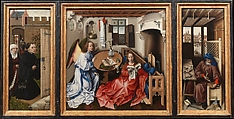
Workshop of Robert Campin
ca. 1427–32
Follower of the Master of Rimini
ca. 1420–30
Canaletto (Giovanni Antonio Canal)
late 1720s
Dutch
ca. 1620
Related Content
Showing 4 of 5
Research Resources
The Met provides unparalleled resources for research and welcomes an international community of students and scholars. The Met's Open Access API is where creators and researchers can connect to the The Met collection. Open Access data and public domain images are available for unrestricted commercial and noncommercial use without permission or fee.
To request images under copyright and other restrictions, please use this Image Request form.
Feedback
We continue to research and examine historical and cultural context for objects in The Met collection. If you have comments or questions about this object record, please contact us using the form below. The Museum looks forward to receiving your comments.