Slifka Foundation Interdisciplinary Fellowship
About the Fellowship
The Slifka Foundation Interdisciplinary Fellowship is a one-year fellowship that combines art historical research with training in the technical investigation of The Met collection.
Slifka fellows work with a curatorial mentor and a conservation and/or scientific research mentor on a specific project proposed by a curator and/or conservator or scientist. While open to both predoctoral and postdoctoral fellows, this fellowship is primarily intended to provide an individual at an early stage of their career with training in technical art history and investigation. If the fellow is predoctoral, they may be permitted to spend some portion of their time on their dissertation, to be determined by mutual agreement with their supervisor.
While two potential fellowship projects are listed below, only one Slifka Foundation Interdisciplinary Fellowship will be awarded for 2027–2028.
2027–2028 Projects:
French Posters in the Department of Drawings and Prints
The Department of Drawings and Prints, working in collaboration with colleagues in the Department of Paper Conservation, invites applications from specialists in 19th-century French art and/or scholars of works on paper to participate in cataloguing, assessing, and studying the collection of 19th-century French posters at The Met.
The Met holds approximately 130 works of fin-de-siècle French posters, only a small fraction of which are currently in the Museum’s collection database (TMS). Dating largely from the 1890s, these posters represent a period of tremendous innovation in graphic design and color printing technologies, as well as the transformation of the status and appreciation of posters as works of art. Most of these works entered the collection in the 1930s and ’40s but have remained largely inaccessible and have never been systematically studied.
Aspects of the project for which the Slifka fellow will be responsible include: organizing and participating in a survey of this area of the collection under the supervision of curators and conservators; cataloguing the posters, including researching and compiling provenance information, exhibition histories, and bibliographic references, and entering this information into TMS; and drafting label texts for the object pages published on the Museum’s website.
The selected fellow will gain invaluable experience in interdisciplinary museum practice and technical art history. They will benefit from the expertise of Met curators and paper conservators and receive training in assessing printmaking techniques and the condition of works on paper. The ideal candidate will have a research focus in late 19th- or early 20th-century art, French language skills, and a commitment to working closely with original objects.
European Manuscript Illumination in the Robert Lehman Collection
The significant corpus of illuminations in the Robert Lehman Collection, last published collectively in a printed collection catalogue in 1997, includes leaves by leading masters such as Lorenzo Monaco and Jean Fouquet. These works originated from well-known manuscript commissions, as well as cuttings by anonymous German, Netherlandish, and Italian masters whose early histories remain unknown. While several miniatures originated as autonomous objects, the majority have been cut from their original codices over the centuries. Renewed scholarship on this material will greatly benefit from advances in the field of conservation and will contribute to a greater understanding of these individual cuttings in relation to sister leaves belonging to the same manuscripts that are housed in other collections. In addition to codicological discoveries, technical examinations will shed significant light on questions of attribution, which are particularly complex in manuscripts that represent collaborative enterprises undertaken by several artists. The online catalogue entries will make important cross-references to sister leaves, including comparative images, that aid in contextualizing the Lehman leaves and reconstructing the manuscripts from which they originated.
The Slifka Foundation Interdisciplinary Fellowship will provide significant training in both the curatorial and conservation fields for a scholar of European manuscript illumination. The proposed project provides the opportunity to conduct in-depth scholarly research and technical examination of the Robert Lehman Collection’s Italian and Northern European illuminations, spanning the 13th to the 16th centuries. This research will be incorporated into a broader project to update and enhance the presentation of the Robert Lehman Collection’s illuminations on the Museum’s website, through the publication of technical examinations, up-to-date scholarship, and catalogue entries integrating these perspectives. This research will also make a significant contribution to future exhibition projects on manuscript illumination.
The Fellowship will provide the scholar with an opportunity to acquire in-depth knowledge of all facets of collection cataloguing and to integrate their research with findings from technical investigations. Over the course of the fellowship, the Slifka fellow will be responsible for conducting research, compiling up-to-date bibliographies, writing short descriptions (web labels) and longer catalogue entries on the corpus of approximately 30 Lehman illuminations, and integrating these findings with new technical examinations undertaken with colleagues in the Department of Paper Conservation. This material will be published on the Museum's online object pages, enabling the Slifka fellow to make a significant contribution to the department’s ongoing endeavor to update scholarship on the collection and make it accessible to a broad public.
The fellow will work in close partnership with colleagues in both the Department of Paper Conservation and the Robert Lehman Collection, who are deeply committed to fostering a welcoming, engaging, and enriching environment to train future generations of those in the curatorial and conservation fields.
- PhD candidates through early-career postdoctoral scholars are eligible to apply.
- Junior fellowships are awarded to applicants who are working on their PhD at the time that they submit their application. Applicants who receive their PhD after the submission deadline are not eligible for the senior fellowship.
- Senior (postdoc) fellowships are awarded to those who hold a PhD on the date of application submission.
- Individuals who are neither US citizens nor permanent residents are eligible to apply for The Met Fellowship Program, provided that they have or are able to obtain valid work authorization under applicable US visa regulations. If you are an international student, fellow, or worker currently in the US on a visa sponsored by another entity (e.g. a university, another museum, or employer), we strongly encourage you to speak to your university’s foreign student office or visa sponsor before applying. If you are currently in the US on an F-1 visa sponsored by a US college or university, you may request CPT or OPT from your school to participate in the Fellowship Program. Please contact your university’s foreign student office prior to applying.
- If you are not currently in the US, The Met may be able to sponsor successful applicants as part of the J-1 Exchange Visitor Program, if they are eligible. Please note that the J-1 Exchange Program has specific regulations about repeat participation in the program; if you currently hold or have held a J-1 visa in the past, we strongly encourage you to visit the BridgeUSA website (j1visa.state.gov) and your current sponsor’s visa office to determine your eligibility to apply for another J-1 visa. Please note that The Met does not reimburse or cover costs incurred during the visa application process.
Stipend
- Junior fellows receive a stipend of $53,000
- Senior fellows receive a stipend of $63,000.
- Travel: Both junior and senior fellows also receive an additional $6,000 for research travel (maximum of six weeks).
- Health insurance: Fellows also receive an additional monthly payment to offset the cost of health insurance.
Application deadline: Thursday, October 15, 2026, 5 pm ET
Notification date: All applicants will be notified by the last Friday in February following the application deadline.
Fellowship period: September 1, 2027 through August 31, 2028
All applications, including letters of recommendation, must be submitted online and in English. The Met will not accept applications or related materials via email, postal mail, or in person.
Slifka Fellowship applicants must submit the following (as .docx or .pdf files):
- A statement of interest, not to exceed 1,000 words, regarding the Slifka Foundation Interdisciplinary Fellowship project. Please describe your area(s) of research and specialization, and explain how this fellowship is uniquely suited to your research and career goals. If you are a PhD candidate currently writing your dissertation, please include a description of your project and, if relevant, how you can use the Museum’s resources and The Met collection to achieve your goals.
- A brief schedule of work to be accomplished during the fellowship period (separate from the statement of interest).
- A brief schedule of travel required (maximum of six weeks) during the fellowship period, if applicable.
- A curriculum vitae of education, professional experience, honors, awards, and publications.
- Three letters of recommendation. Applicants must submit at least one academic and one professional letter of recommendation. All letters must be submitted in English and uploaded directly by the recommenders. Recommenders may not be current Met staff, contractors, or volunteers.
- Official transcripts (undergraduate and graduate)—for predoctoral (junior) fellowship applicants only
If you have not yet completed your PhD, you must upload a copy of your undergraduate transcript and graduate transcript. If you have transcripts from more than one institution for either category (undergraduate or graduate), please upload them as one combined file.
What to Expect After Applying
Once submitted, staff in relevant department(s) first review your application to assess the quality and feasibility of your application according to the criteria set forth on the evaluation rubric. If your proposal meets the necessary criteria, the department(s) recommend it for review by The Met’s Grants Committee, which consists of members of The Met’s professional staff appointed by the Museum’s Director and Chief Executive Officer. The committee reviews all aspects of each application submitted, using the evaluation rubric (see below). Following this assessment, the Grants Committee submits final award recommendations to the Director and CEO for review and approval. You are notified regarding the result of your application by the last Friday in February.
Please note that due to the lengthy and multiperspective review process, we are unable to provide individual feedback on applications that are not selected.
Selection Criteria
Applications are evaluated based on the criteria set forth in The Met’s evaluation rubric. Reviewers consider all your application materials: your statement of interest, digital interpretation statement, writing sample, CV, and letters of recommendation. They use the rubric to score your application, but this serves only as a guide. There is no cut-off score for progressing in the review process or being awarded a fellowship. View the evaluation rubric. (PDF)
Life as a Met Fellow
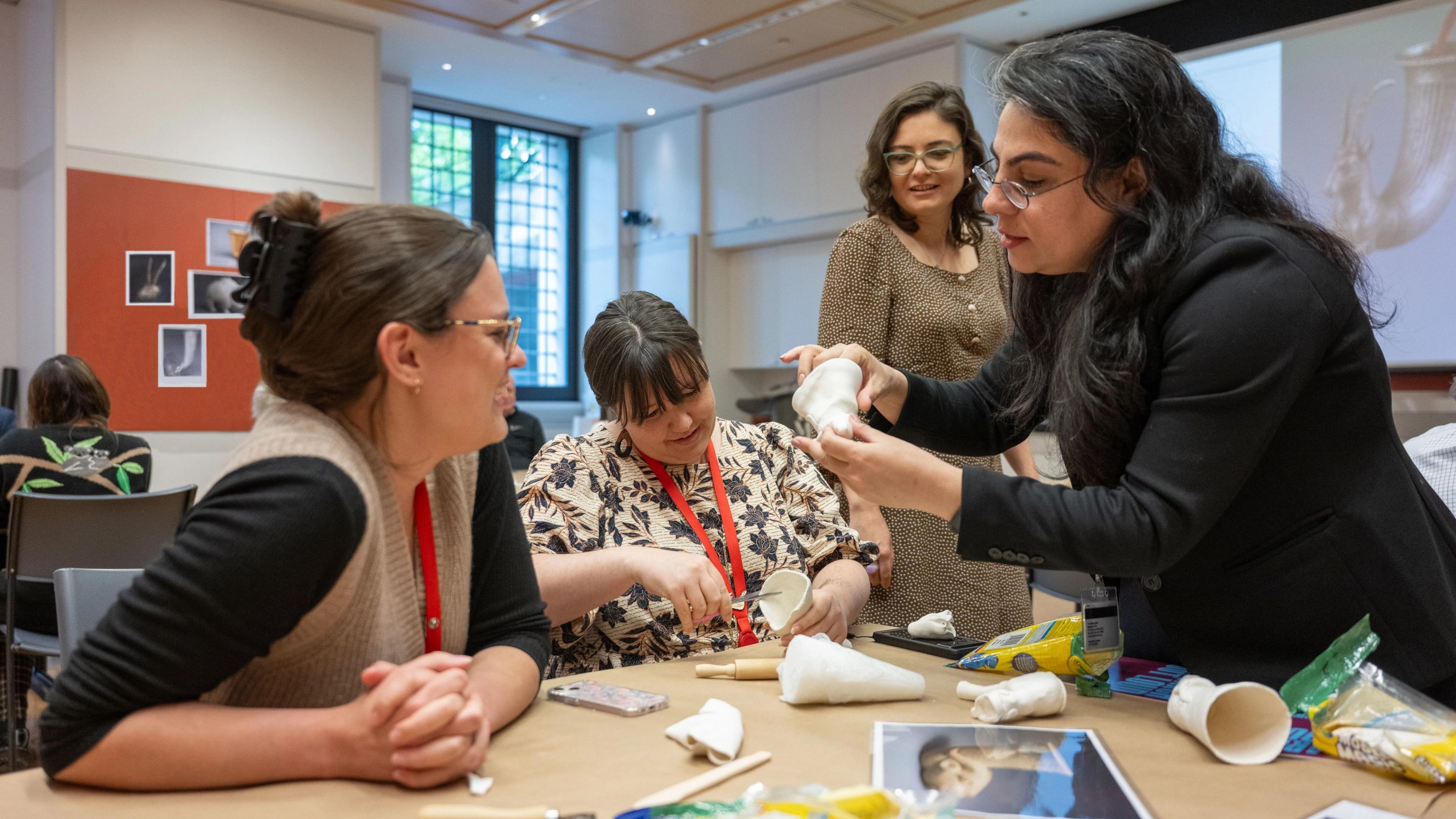
Research Support, Community, and Professional Development
Fellows receive financial support, time for research, exposure to museum work, and access to The Met collection and libraries. Weekly programs and workshops bring fellows together with Met staff to share ideas, develop professional skills, and discuss current issues in museum practice.
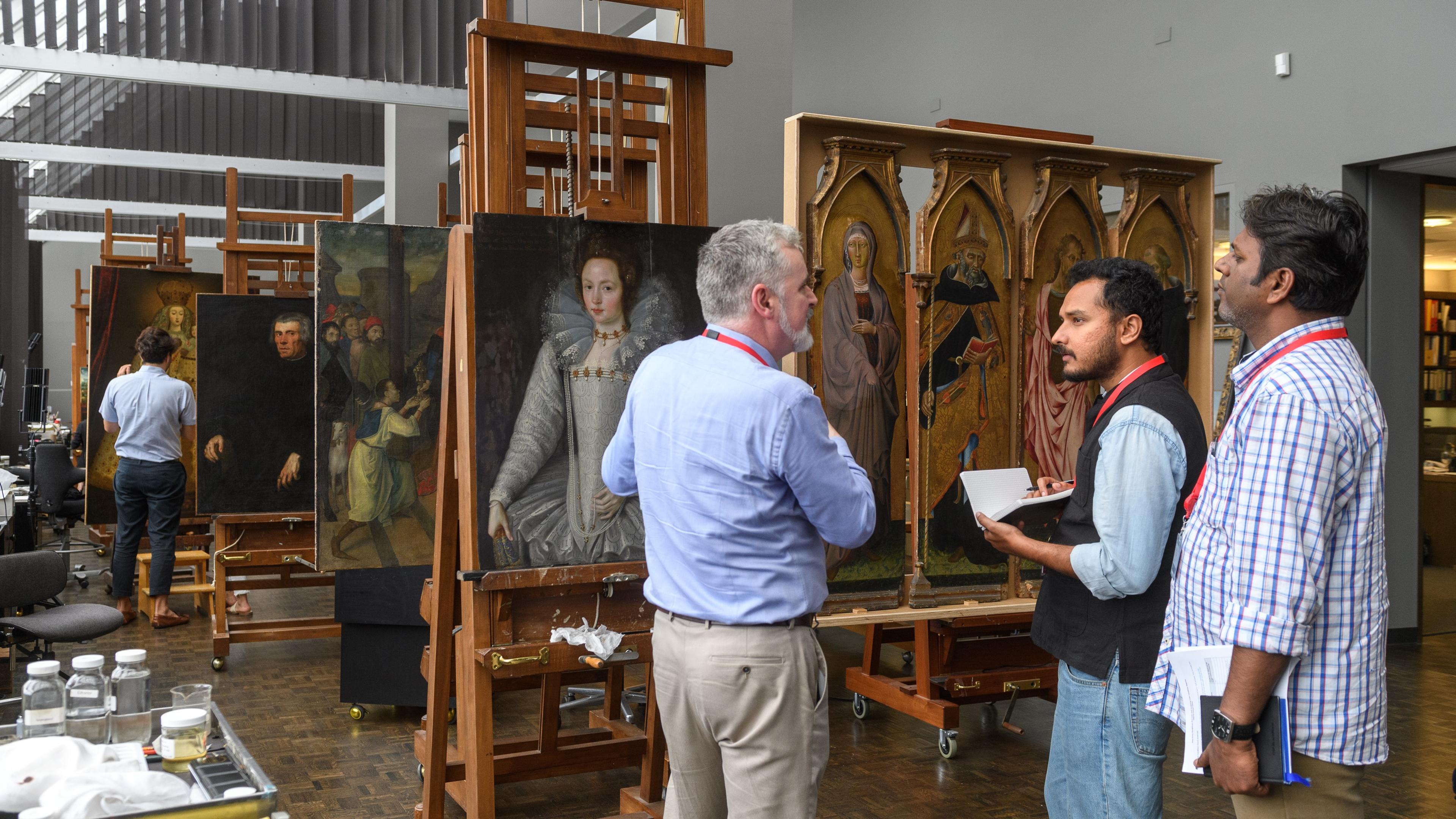
Departmental Placement
Fellows are embedded in a curatorial, conservation, audience engagement, or scientific research department with a dedicated Met staff supervisor. Browse curatorial and conservation departments. The Education, Digital, Met Live Arts, and Archives departments also host Interdisciplinary Fellows.
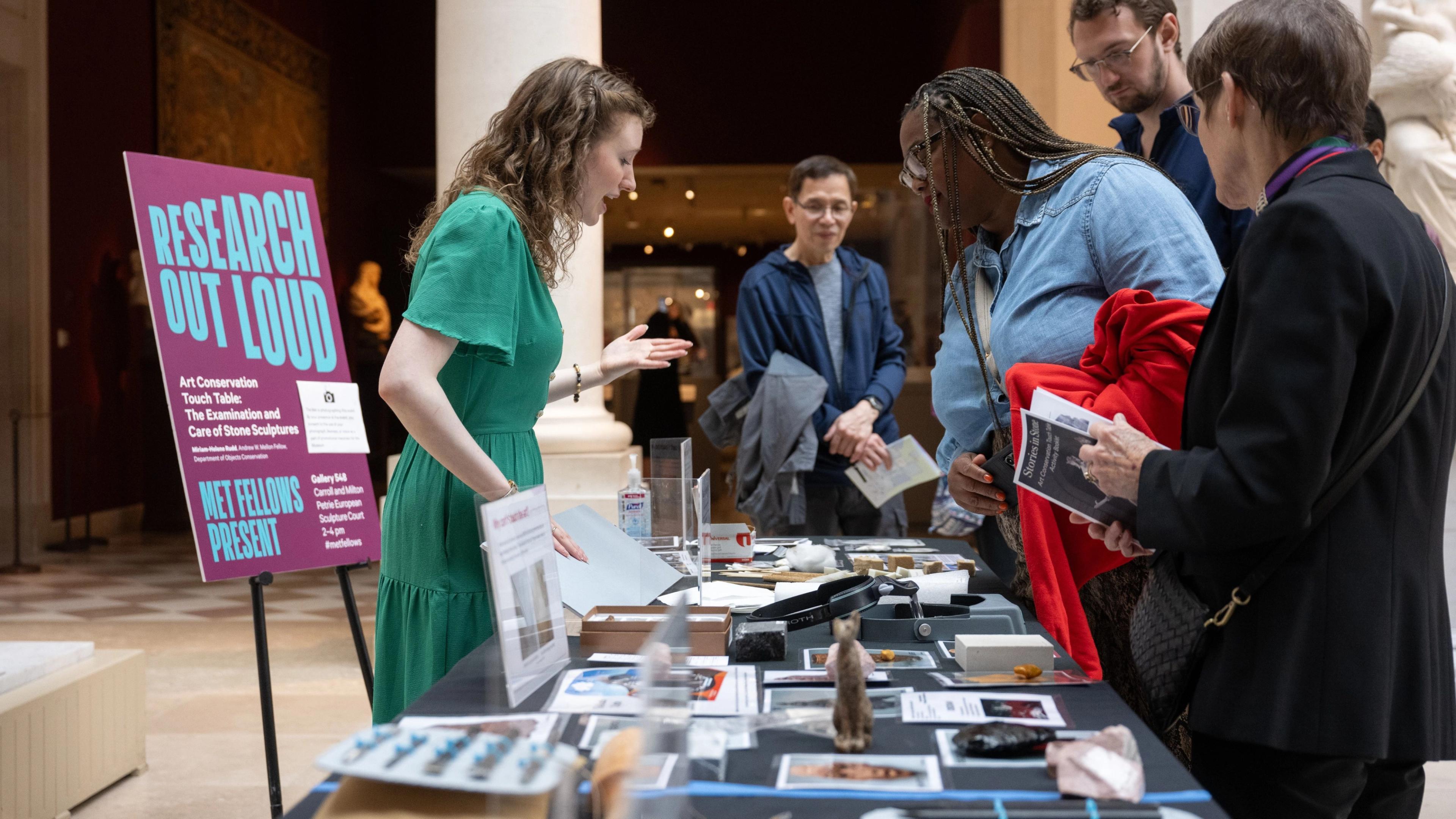
Research Out Loud: Met Fellows Present
Research Out Loud: Met Fellows Present connects the fellows with the public through a series of gallery programs and research presentations that offer cross-cultural and transhistorical connections throughout The Met collection.
Helpful Links for Fellowship Applicants